By Dr. Laureano Giraldez-Rodriguez, MD, FACS
When a patient is diagnosed with a tumor in the throat, the fear and uncertainty are enormous. One of the first questions that comes up is: will I need surgery? And the second, almost immediately: what will happen to my voice? Will I be able to swallow afterward? These questions are completely valid, and the good news is that today we have technology that lets us operate on throat tumors in a way that was unthinkable just a few years ago.
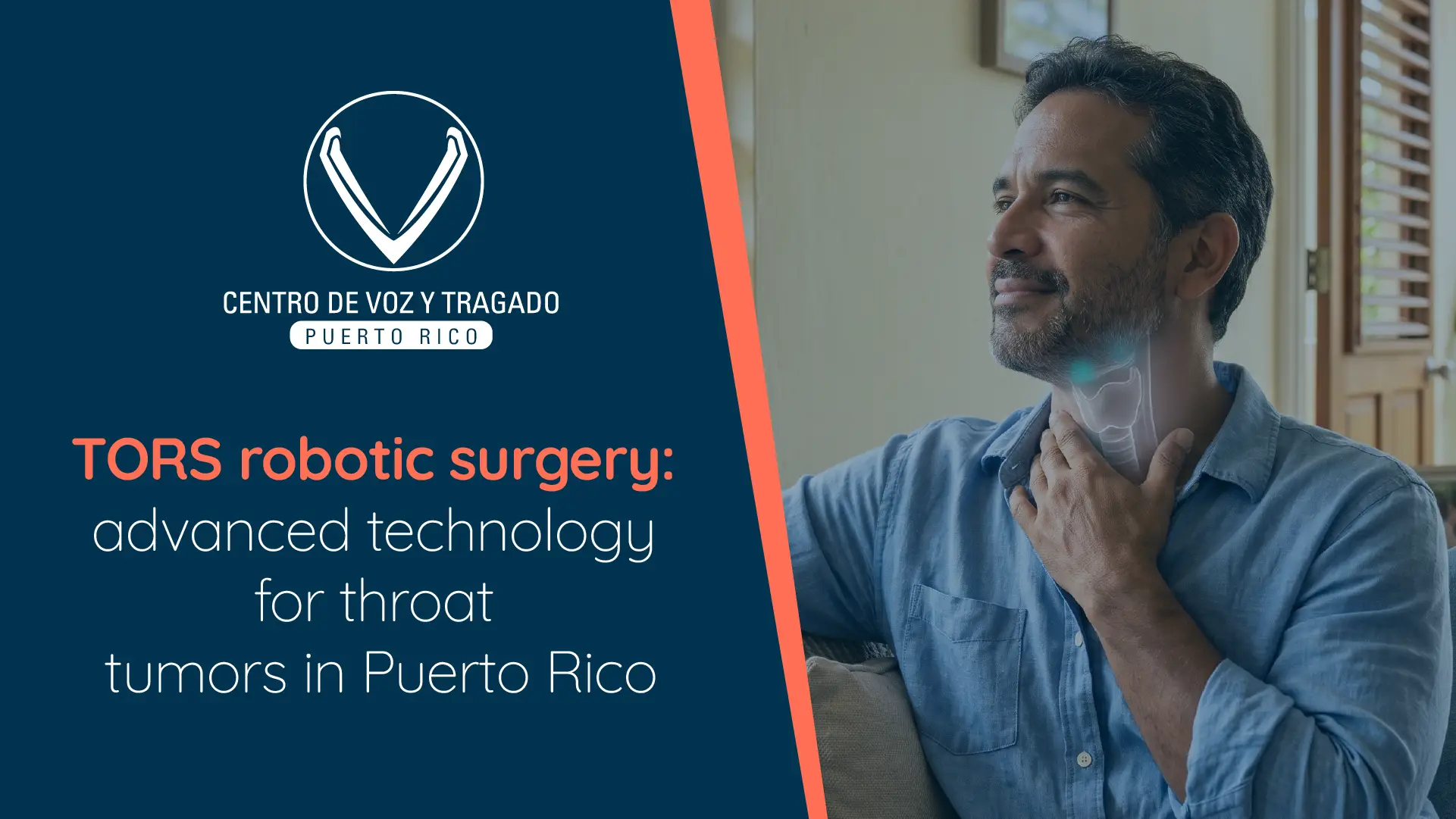
That’s why I want to talk to you about transoral robotic surgery, known as TORS, which is changing the way we treat throat tumors.
What is transoral robotic surgery?
TORS stands for TransOral Robotic Surgery. It’s an advanced surgical technique that allows the surgeon to operate on tumors in the throat by accessing them through the mouth, without needing to make incisions in the neck or jaw. It uses a surgical robotic system that gives the surgeon miniaturized articulated arms with high-precision instruments and a high-definition three-dimensional camera, all controlled from a console.
The robotic system doesn’t operate on its own. The surgeon controls every movement. The robot is simply an extremely precise tool that amplifies the surgeon’s dexterity, allowing them to work in very tight spaces with a precision the human hand alone can’t achieve.
What types of tumors can be treated with TORS?
TORS surgery is particularly useful for tumors of the oropharynx, which includes the tonsils, the base of the tongue, the posterior pharyngeal wall, and the soft palate. These are precisely the sites where cancers associated with the human papillomavirus tend to appear, a trend that is increasing.
It can also be used for tumors of the supraglottic larynx, certain hypopharyngeal tumors, and to access benign lesions in areas that are difficult to reach through traditional approaches.
Advantages over traditional surgery
The advantages of TORS over traditional surgical approaches are significant. By operating through the mouth, we avoid external incisions on the neck or face, which eliminates visible scarring. There’s no need to split the jaw, a procedure called mandibulotomy, which was previously necessary to access many throat tumors. This means less postoperative pain, a faster recovery, and a shorter hospital stay.
But perhaps the most important advantage is functional preservation. Because it’s more precise and less traumatic, TORS surgery allows us to better preserve swallowing and speech function. Patients recover the ability to swallow and speak normally more quickly, which has a huge impact on their quality of life.
Additionally, when TORS completely removes the tumor, many patients can avoid or reduce the need for postoperative radiation therapy or chemotherapy, meaning fewer treatment side effects.
What is the patient experience like?
The procedure is performed under general anesthesia. The surgeon places a retractor in the mouth to keep it open and expose the tumor area. Then the robotic arms with the instruments and camera are positioned through the mouth. From the console, the surgeon operates with millimeter precision, removing the tumor with margins of healthy tissue around it.
Most patients spend one to three days in the hospital after surgery. Pain is managed with pain medication, and eating resumes gradually. Some patients can start drinking liquids the same day as surgery.
It’s important to be transparent: recovery includes a period of significant throat pain, similar to a tonsillectomy but more intense, that can last two to three weeks. During this time, eating can be difficult, and some patients temporarily lose weight. But in the vast majority of cases, swallowing function and voice recover completely.
TORS and HPV-associated cancer
One of the reasons TORS has gained so much relevance is the rise in HPV-associated oropharyngeal cancers. These patients tend to be younger and have an excellent survival rate. For them, quality of life after treatment is a crucial factor. TORS offers them the chance to be cured with fewer functional after-effects, allowing them to return to their normal lives more quickly.
Availability in Puerto Rico
As a surgeon trained in this technology, I’m proud to be able to offer this option to patients in Puerto Rico. Previously, many patients had to travel to access robotic head and neck surgery. Today, they can receive this state-of-the-art treatment right here on the island.
That said, I want to be clear: TORS isn’t the solution for every tumor. The decision about the best treatment is made on an individualized basis, taking into account the type of tumor, its location, its size, the stage of the disease, and the patient’s overall condition.