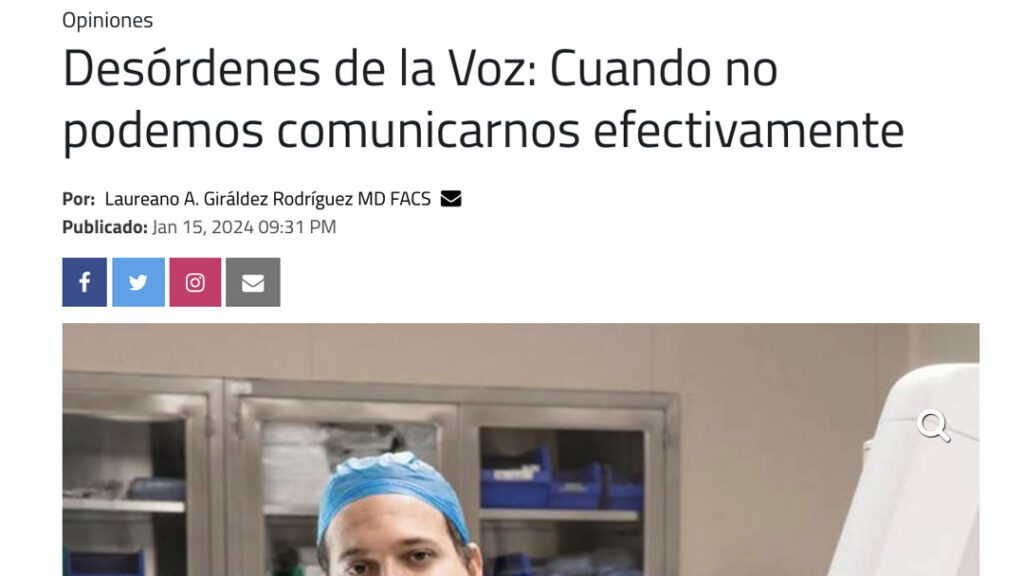
By Dr. Laureano Giraldez-Rodriguez, MD, FACS
If you’re a singer, teacher, actor, sports coach, or any professional who depends on their voice, vocal nodules are probably the condition you fear most. And rightly so: they can change how you sound, limit your range, and threaten your career. But I also want to reassure you: vocal nodules are treatable, and in most cases, your voice can fully recover.
What exactly are vocal nodules?
Vocal nodules are benign lesions that form on the free edge of the vocal cords, right at the point where the vocal cords collide with the most force during vibration. They’re bilateral, meaning they appear on both vocal cords in symmetrical positions, like calluses that form on the hands of a manual laborer.
The best analogy is exactly that: just as repeatedly rubbing the skin produces calluses, repeated trauma to the vocal cords from speaking or singing with improper technique or excessive effort produces thickenings on the vocal cords that we call nodules.
In their early stages, nodules are soft and inflammatory, almost like blisters. Over time and with continued irritation, they become firmer and more fibrotic, like harder calluses. This distinction matters because soft nodules respond much better to conservative treatment than mature, fibrotic nodules.
Who develops them?
Vocal nodules are more common in young women and in people who use their voice professionally. Singers are perhaps the best-known group, and in fact famous artists like Adele, Meghan Trainor, Sam Smith, and many others have spoken publicly about their experience with vocal nodules.
But singers aren’t the only ones who develop them. Teachers are another high-risk group. Lawyers, salespeople, broadcasters, receptionists, sports coaches, and children who yell frequently are also vulnerable. On our island, where we’re expressive and passionate speakers, it’s no surprise we see many cases.
What are the symptoms?
The main symptom is hoarseness, a voice that sounds raspy, rough, or breathy. But there are other symptoms that can be more subtle. Vocal fatigue, where the voice tires by the end of the day, is very common. Loss of vocal range, especially high notes, is enormously frustrating for singers. Involuntary breaks or cuts in the voice while speaking or singing are characteristic. The need for more effort to produce the same voice as before, and a sensation of tension or pain in the neck while speaking, are also common.
In singers, one of the first symptoms can be difficulty singing piano, that is, softly, since nodules prevent the vocal cords from coming together delicately.
How are they diagnosed?
Diagnosis is made through an endoscopic evaluation of the vocal cords, ideally with videostroboscopy. This exam lets us see the nodules directly and, more importantly, assess how they’re affecting vocal cord vibration. Small nodules can be hard to see with a basic exam, which is why stroboscopy is essential for an accurate diagnosis.
In addition to the visual exam, we perform a functional voice evaluation that includes acoustic and aerodynamic measurements to objectively document how your vocal mechanism is working.
Treatment: voice therapy first
The cornerstone of vocal nodule treatment is voice therapy with a speech-language pathologist specialized in voice. This isn’t generic therapy but a personalized program that addresses the specific vocal behaviors that caused the nodules in the first place.
Therapy includes education on voice anatomy and physiology, identification of the vocal use patterns causing the trauma, exercises to improve vocal technique while reducing tension and impact on the vocal cords, training in vocal hygiene to keep the vocal cords healthy, and, for singers, specific work on singing technique that protects the voice.
The length of therapy varies, but generally six to twelve weeks of weekly sessions are needed to see significant results. Consistency is key: the exercises must be practiced daily outside of therapy sessions.
When is surgery needed?
Surgery is considered when nodules are mature and fibrotic and don’t respond to voice therapy, or when symptoms are severe enough that the person can’t function professionally. Microlaryngoscopy is the standard surgical procedure, in which, under general anesthesia and using microscopic instruments or a laser, the nodules are removed while preserving as much healthy tissue as possible.
It’s essential to understand that surgery without follow-up voice therapy is a recipe for recurrence. If the vocal patterns that caused the nodules aren’t corrected, they’ll come back. That’s why, in my practice, pre- and postoperative voice therapy is a non-negotiable part of the surgical treatment plan.
Vocal nodules are not a life sentence. With the right treatment, the vast majority of people fully recover their voice. The most important thing is not to ignore the symptoms and to seek help early, before the nodules become chronic and fibrotic.