By Dr. Laureano Giraldez-Rodriguez, MD, FACS
One of the questions I get most often from patients with benign thyroid nodules is: should I have surgery, or is there another option? And increasingly, the answer includes radiofrequency ablation, or RFA. Today I want to give you an honest, detailed comparison of both options so you can make the most informed decision possible.
What exactly is thyroid radiofrequency ablation?
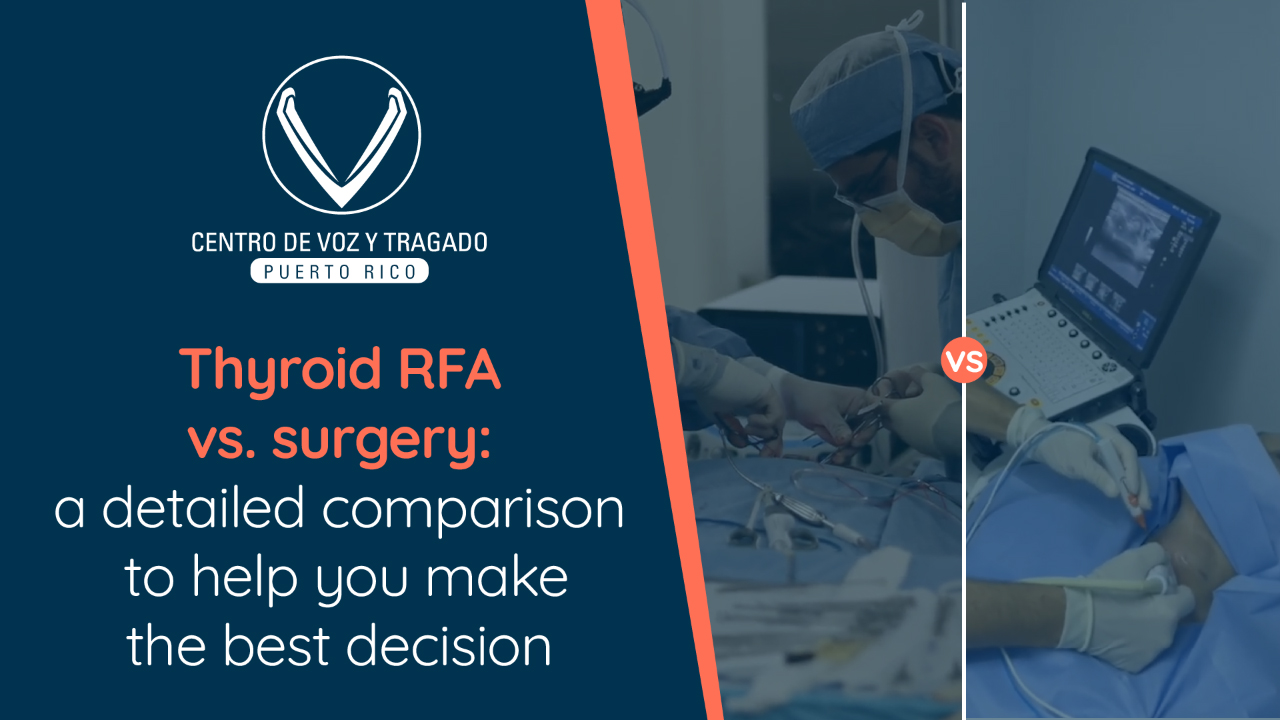
RFA is a minimally invasive procedure that uses radiofrequency energy, essentially controlled heat, to reduce the size of benign thyroid nodules. It is performed using a special needle that is inserted directly into the nodule under ultrasound guidance, and the thermal energy gradually destroys the nodule tissue, which is then reabsorbed by the body over the following months.
The procedure is performed under local anesthesia, in the office or an outpatient center, and typically takes between 20 and 40 minutes depending on the size of the nodule. The patient is awake and can communicate with the team throughout the entire procedure.
Traditional surgery: lobectomy or thyroidectomy
Thyroid surgery, whether removing one lobe (lobectomy) or the entire gland (total thyroidectomy), has been the standard of care for decades. It is performed under general anesthesia in the operating room, requires an incision in the neck, and typically involves a hospital stay of one to two days.
Surgery completely removes the nodule or the affected gland, also providing tissue for definitive pathological analysis. It is the indicated treatment for malignant or suspicious nodules.
Head-to-head comparison: point by point
Regarding appropriate candidates, RFA is indicated for benign thyroid nodules confirmed by biopsy that cause symptoms such as pressure, difficulty swallowing, or cosmetic concern. Surgery is appropriate for symptomatic benign nodules, malignant nodules, nodules with indeterminate biopsy results, and when a definitive histological diagnosis is needed.
Regarding the procedure itself, RFA uses local anesthesia, lasts between 20 and 40 minutes, does not require hospitalization, and leaves a minimal puncture mark that disappears. Surgery requires general anesthesia, lasts one to three hours, requires hospitalization, and leaves a permanent scar on the neck measuring three to six centimeters, which, although it generally conceals well, is permanent.
In terms of reduction results, RFA typically achieves a nodule volume reduction of 50 to 80% over the six to twelve months following the procedure. Surgery removes the nodule or gland completely, with an immediate and definitive result.
Recovery with RFA is quick: most patients return to normal activities within one to two days. Surgical recovery takes two to four weeks for full activity.
Regarding thyroid function, RFA preserves the thyroid gland and its function, so most patients do not need hormone replacement medication. After a lobectomy, approximately 20 to 30 percent of patients require hormone replacement. After a total thyroidectomy, one hundred percent of patients require lifelong levothyroxine.
Risks and complications
RFA has a generally favorable risk profile. The most common complications are mild pain during or after the procedure, a hematoma at the puncture site, and, rarely, temporary voice changes if the nodule is very close to the recurrent laryngeal nerve. Serious complications are infrequent.
Surgery carries risks that include injury to the recurrent laryngeal nerve, which can affect the voice temporarily or permanently; temporary or permanent hypoparathyroidism affecting calcium levels; postoperative hematoma; surgical wound infection; and risks associated with general anesthesia.
When do I recommend RFA and when do I recommend surgery?
In my practice, I recommend RFA when the nodule is benign and confirmed by at least two biopsies, when it causes compressive symptoms or cosmetic concern, when the patient prefers to avoid surgery and general anesthesia, and when the nodule’s anatomy is favorable for the procedure.
I recommend surgery when there is suspicion or confirmation of malignancy, when the biopsy is indeterminate and histological diagnosis is needed, when there are extensive multinodular goiters, when there is hyperthyroidism that does not respond to other treatments, and when the nodule has characteristics that make RFA technically difficult.
At the end of the day, my recommendation is always based on what is best for each individual patient, taking into account their anatomy, their diagnoses, their preferences, and their lifestyle.
The most important thing is to have an open and honest conversation. There is no universally perfect option. There is the right option for you, and finding it requires an informed dialogue between physician and patient.