By Dr. Laureano Giraldez-Rodriguez, MD, FACS
You had a thyroid ultrasound, and the report says you have multiple thyroid nodules: a multinodular goiter. The worry sets in right away, is it cancer? Do I need surgery? Am I going to lose my thyroid?
Having multiple nodules is far more common than you’d think, and in most cases it doesn’t require surgery. But it does call for careful evaluation. Here’s everything you need to know.
What is a multinodular goiter?
A multinodular goiter is simply a thyroid that contains two or more nodules. The thyroid is a butterfly-shaped gland located at the front of the neck that produces hormones essential for metabolism. Over time, especially in women and people over 50, it’s very common for nodules to develop in the thyroid.
To put it in perspective, if we did a thyroid ultrasound on everyone over 60, we’d find nodules in more than 50% of them. The vast majority of these nodules are completely benign. Having many nodules doesn’t mean you have a higher chance of cancer, in fact, the cancer risk per individual nodule is similar to, or even lower than, the risk in a single, solitary nodule.
Why do nodules form?
Thyroid nodules can form for several reasons. Iodine deficiency was historically an important cause, though it’s less relevant today thanks to iodized salt. Genetics plays a significant role: if your parents or siblings have thyroid nodules, you’re more likely to develop them too. Hormonal fluctuations, especially during pregnancy, can stimulate nodule growth. And simply normal aging contributes to their formation.
The evaluation: which nodules deserve attention?
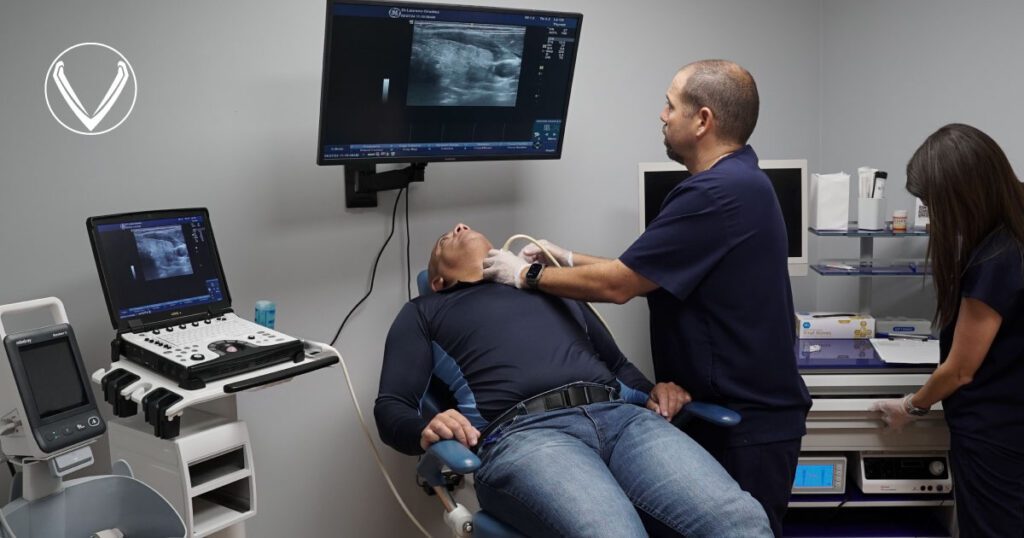
When you have multiple nodules, it’s neither necessary nor practical to biopsy all of them. The key is identifying which ones have suspicious features. This is done with a high-resolution ultrasound, where we assess each nodule using standardized criteria such as the American College of Radiology’s TI-RADS system.
The features that concern us include solid nodules with irregular margins, the presence of microcalcifications, nodules taller than they are wide, and nodules with markedly reduced echogenicity. We also pay special attention to the dominant nodule, the largest in the group, and to any nodule that has grown significantly on previous evaluations.
If a nodule meets suspicious criteria and is at least one centimeter in diameter, we recommend a fine-needle aspiration biopsy. This procedure is done in the office, guided by ultrasound, and is generally well tolerated.
Compressive symptoms: when size matters
Although most multinodular goiters are asymptomatic, when the thyroid grows large enough it can compress the surrounding structures. Compressive symptoms include difficulty swallowing, especially with solid foods, a sensation of pressure or a lump in the neck, difficulty breathing, especially when lying down, and voice changes if the goiter affects the recurrent laryngeal nerve.
One particular type of goiter that requires special attention is a substernal or retrosternal goiter, where part of the thyroid extends into the chest behind the breastbone. These goiters can compress the trachea and the large blood vessels, and generally require surgical treatment.
When is surgery recommended?
Indications for surgery in a multinodular goiter include suspected or confirmed cancer in any nodule, significant compressive symptoms affecting swallowing or breathing, progressive growth despite monitoring, a substernal goiter, and hyperthyroidism caused by autonomous nodules that doesn’t respond to medical treatment.
Surgery may be a total thyroidectomy, where the entire gland is removed, or a lobectomy, where only one side is removed. The decision depends on how the nodules are distributed, the biopsy results, and other individual factors.
My approach: smart active surveillance
In my practice, I firmly believe in not operating unnecessarily. If your nodules are benign on biopsy, aren’t causing symptoms, and thyroid function is normal, active surveillance with periodic ultrasounds is the best approach. This means evaluations every 12 to 24 months to monitor the size and characteristics of the nodules. If something changes, we act. But there’s no reason to put a patient through surgery they don’t need.