By Dr. Laureano Giraldez-Rodriguez, MD, FACS
One of the most common concerns I hear when discussing thyroid surgery with my patients is the scar. “Am I going to have a big mark on my neck?” is practically a universal question, especially among young women. And it’s a completely valid concern. The neck is one of the most visible areas of the body, and a prominent scar can affect a person’s confidence and self-image.
The good news is that thyroid surgery has evolved enormously. Today we have minimally invasive techniques that significantly reduce the size of the incision without compromising the safety or the results of the procedure.
Traditional thyroid surgery
Conventional thyroidectomy is performed through a horizontal incision at the base of the neck, typically along a natural skin crease. Historically, this incision measured between 6 and 10 centimeters. In the hands of an experienced surgeon with meticulous closure, the scar can become fairly discreet over time, but it remains visible, especially in people prone to hypertrophic or keloid scarring.
This technique has been the standard for more than a century and has excellent oncologic outcomes. Any evolution in technique has to maintain those same safety standards, that’s not negotiable.
What is minimally invasive thyroid surgery?
Minimally invasive thyroid surgery encompasses several techniques that share a common principle: achieving the same surgical goals through smaller incisions, or through approaches that hide the scar in less visible areas.
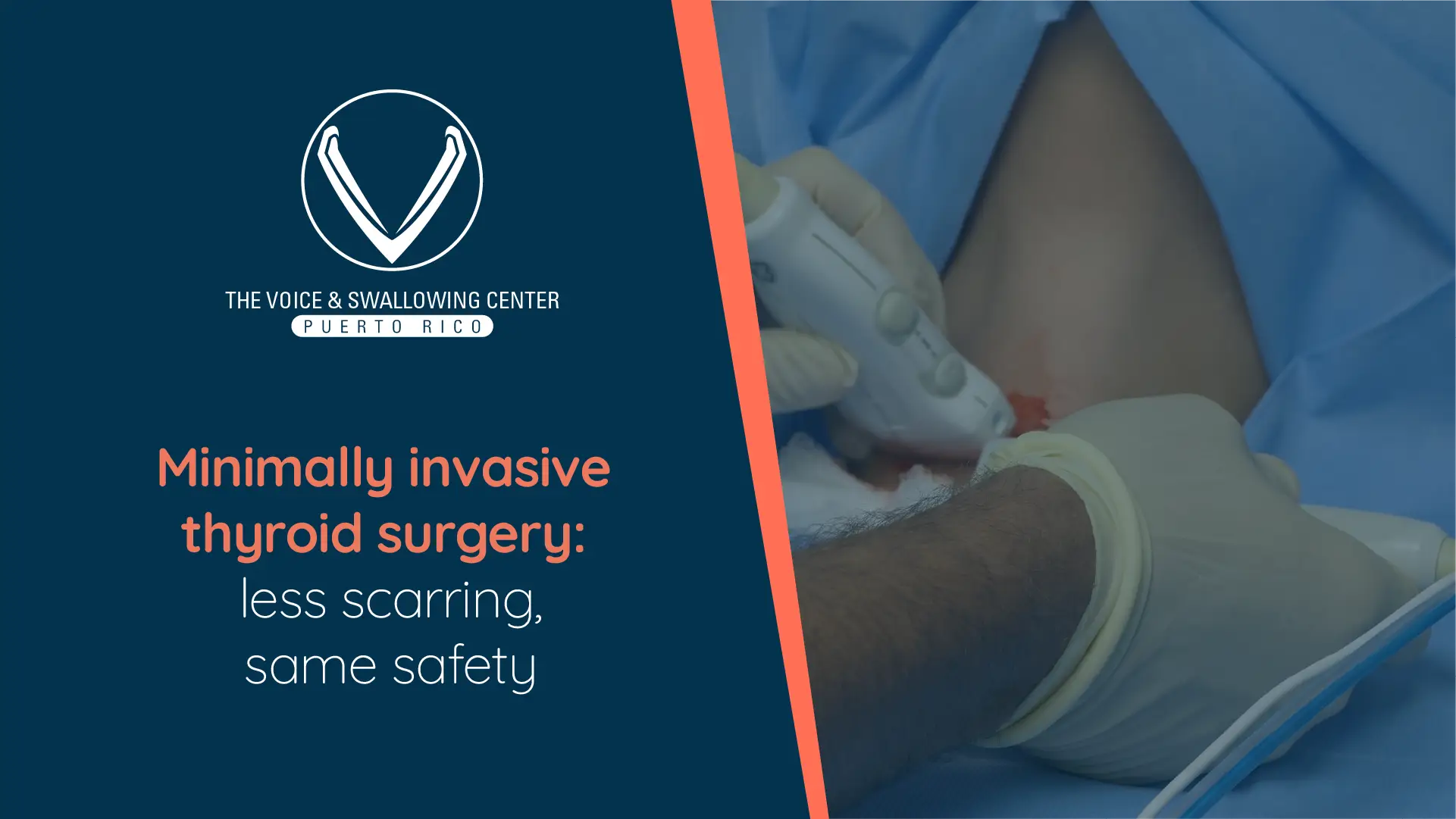
Minimally invasive thyroidectomy with a reduced cervical incision uses a 2 to 3 centimeter incision, compared to the 6 to 10 centimeters of the conventional technique. Through this small window, using specialized instruments and, in many cases, video-endoscopic assistance, we can perform the same operation with the same meticulousness.
The key is visual magnification so that I can see the anatomical structures in greater detail than with the naked eye. The recurrent laryngeal nerves, the parathyroid glands, the blood vessels — everything is visualized with greater clarity, which potentially improves safety.
Who is a candidate?
Not every patient is a candidate for the minimally invasive technique. Selection criteria matter to ensure safety. The best candidates are patients with thyroid nodules up to four centimeters that require a lobectomy, patients with moderately sized goiters, and certain cases of low-risk papillary thyroid carcinoma.
Patients with very large goiters extending into the chest, locally advanced thyroid cancer, extensive prior neck surgery, or particularly complex anatomy may require the conventional approach to ensure a safe and complete surgery.
It’s essential that the surgeon has the flexibility and the honesty to convert to a larger incision if circumstances require it during the procedure. Safety always takes priority over aesthetics.
Recurrent laryngeal nerve monitoring
One of the tools I consider essential in modern thyroid surgery, whether minimally invasive or conventional, is intraoperative monitoring of the recurrent laryngeal nerve. This system uses a special endotracheal tube with electrodes that detect electrical activity in the vocal cords.
During surgery, I can stimulate the recurrent laryngeal nerve and confirm its functional integrity. If the nerve’s signal weakens or is lost during dissection, it alerts me immediately so I can adjust my technique and protect the structure. It’s like having a GPS for the most important nerve in thyroid surgery.
This monitoring is particularly valuable in minimally invasive surgery, where the surgical field is smaller and visual identification of the nerve can be more challenging.
Results and recovery
The results of minimally invasive thyroid surgery, in terms of oncologic effectiveness and complication rate, are comparable to the conventional technique when performed by experienced surgeons in well-selected patients. This has been shown in multiple comparative studies.
Where there are notable differences is in cosmetic results and recovery. The smaller incision generally results in less postoperative pain, less neck swelling, and a significantly more discreet scar. Many patients can return to their normal activities in 3 to 5 days, compared to one to two weeks with the conventional technique.
Patient satisfaction with the cosmetic outcome is consistently high. After a few months, the 2 to 3 centimeter scar can be practically imperceptible, especially when it’s placed along a natural crease in the neck.
In my experience
In my practice, I use the minimally invasive technique as my preferred approach for most candidate patients. However, I’m always transparent with my patients: the size of the scar matters, but it’s secondary to the safety and completeness of the surgery.
Every patient receives an individualized evaluation where we discuss the surgical options, the risks and benefits of each approach, and reach a decision together. My commitment is to offer the safest possible surgery with the best achievable functional and cosmetic outcome.
Scar care
Regardless of the technique used, postoperative scar care influences the final result. I recommend strict sun protection of the scar for at least six months: sun exposure darkens scars and makes them more visible. Using silicone patches or gel starting two to three weeks after surgery has been shown to reduce hypertrophic scar formation. And gently massaging the scar once it has fully closed helps maintain tissue flexibility.
If you have a thyroid nodule that needs surgery and the scar is a concern for you, let’s talk. Together we can find the best option for your specific case.