By Dr. Laureano Giraldez-Rodriguez, MD, FACS
If you’ve been diagnosed with a benign thyroid nodule, you’ve probably been told you have two options: watch it or have surgery. But what if I told you there’s a third option? A minimally invasive alternative that can significantly reduce the size of your nodule without surgery, without scars, and without the need to take thyroid hormone for the rest of your life. That option is radiofrequency ablation, known as RFA, and we are proud to offer it here in Puerto Rico.
I’m Dr. Laureano Giraldez, and as part of my commitment to offering the most advanced options to my patients, I have trained in this technique that is transforming the management of thyroid nodules around the world.
What are thyroid nodules?
The thyroid is a butterfly-shaped gland located at the front of the neck that produces hormones essential for your body’s metabolism. Thyroid nodules are growths or lumps within the thyroid gland that are extremely common. It is estimated that up to 65 percent of the general population has thyroid nodules, although most are small and never cause problems.
However, some nodules grow large enough to cause symptoms: pressure in the neck, difficulty swallowing, the sensation of a visible lump, or discomfort when wearing necklaces or ties. Others are discovered incidentally during imaging studies for other reasons. Although the vast majority are benign, it is always necessary to evaluate them properly to rule out malignancy.
The problem with traditional options
Historically, the management of a benign but symptomatic thyroid nodule has been binary: watch and wait, or surgery. Observation works when the nodule is small and causes no symptoms, but it can be frustrating when the nodule keeps growing. Surgery, whether a lobectomy that removes half the thyroid or a total thyroidectomy, is effective but carries real risks: a scar on the neck, possible damage to the nerves that control the voice, risk of hypoparathyroidism, general anesthesia, and in many cases the need to take levothyroxine for life.
For a nodule we know is benign, subjecting a patient to major surgery sometimes feels disproportionate. And that is where radiofrequency ablation comes in.
What is thyroid radiofrequency ablation?
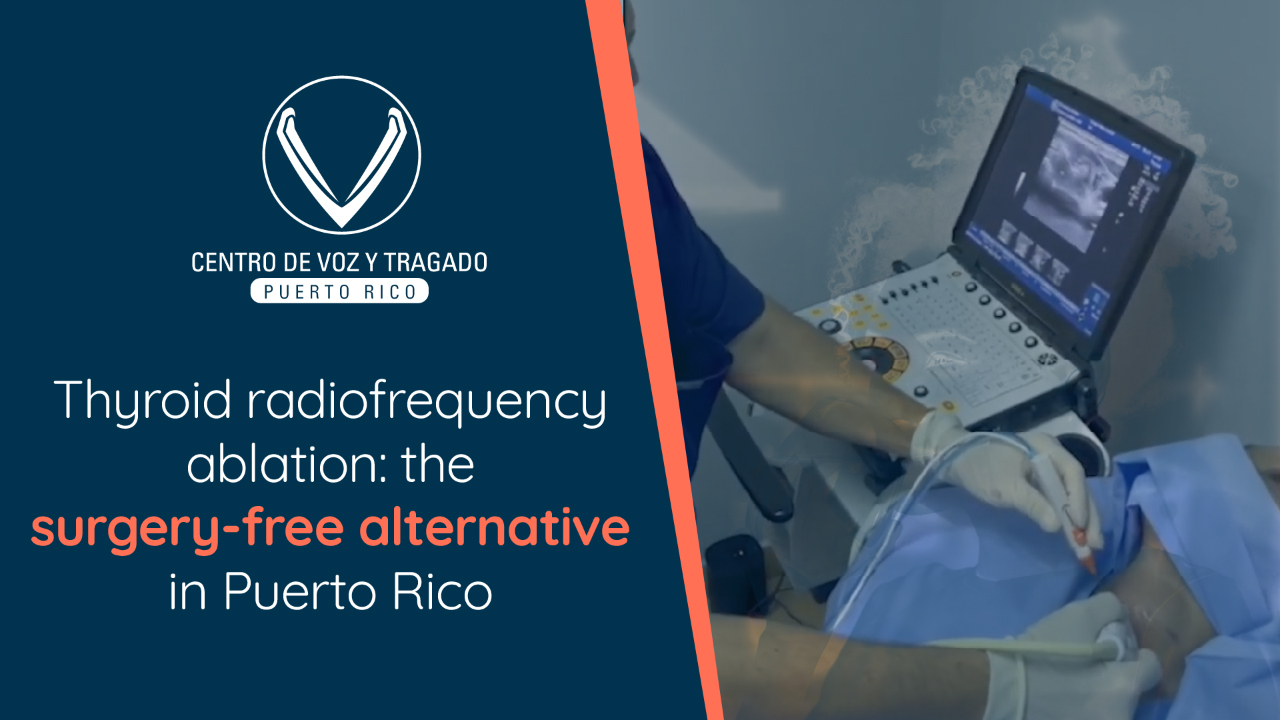
RFA is a minimally invasive procedure that uses radiofrequency energy to selectively heat and destroy the tissue of the thyroid nodule. It is performed through a special needle inserted directly into the nodule under real-time ultrasound guidance. The heat generated by the radiofrequency causes necrosis of the nodule tissue, and over time the body reabsorbs that tissue, significantly reducing the size of the nodule.
What is the procedure like?
This is one of the aspects that surprises my patients the most. RFA is performed on an outpatient basis, at our center, with local anesthesia. It does not require general anesthesia or hospitalization. The procedure typically lasts between 30 and 60 minutes, depending on the size of the nodule.
During the procedure, the patient is awake and comfortable. We constantly monitor the position of the needle and the effect of the treatment in real time using ultrasound. We use the moving shot technique, which allows us to treat the nodule uniformly while protecting the surrounding structures.
What are the results?
International studies and our own experience show impressive results. On average, nodules are reduced by 50 to 80% of their original volume during the first 6 to 12 months after the procedure. Many patients report relief of their symptoms within a few weeks. Thyroid function is preserved in the vast majority of cases, meaning most patients do not need to take thyroid hormone after the procedure.
Complication rates are very low. The most common side effects are mild pain at the procedure site and some swelling, which generally resolve within a few days. Serious complications, such as voice changes or infection, are extremely rare when the procedure is performed by a physician with proper training.
Who is a candidate for RFA?
Not every thyroid nodule requires or is appropriate for RFA. Ideal candidates are patients with benign thyroid nodules confirmed by biopsy that are causing symptoms or cosmetic concern. It may also be an option for autonomous thyroid nodules causing hyperthyroidism. It is not appropriate for nodules with suspicion of malignancy.
The evaluation includes a detailed ultrasound and a fine needle aspiration biopsy to confirm that the nodule is benign before proceeding with treatment.
Puerto Rico at the forefront
I am proud to say that we are offering this cutting-edge technology here on our island. Many patients previously had to travel outside of Puerto Rico to access this type of treatment. Now, they can receive world-class care without leaving home.
My philosophy has always been to offer my patients all available options, explain the pros and cons of each, and help them make the best decision for their particular situation. RFA does not replace thyroid surgery; it complements it as an additional tool in our therapeutic arsenal.