By Dr. Laureano Giraldez-Rodriguez, MD, FACS
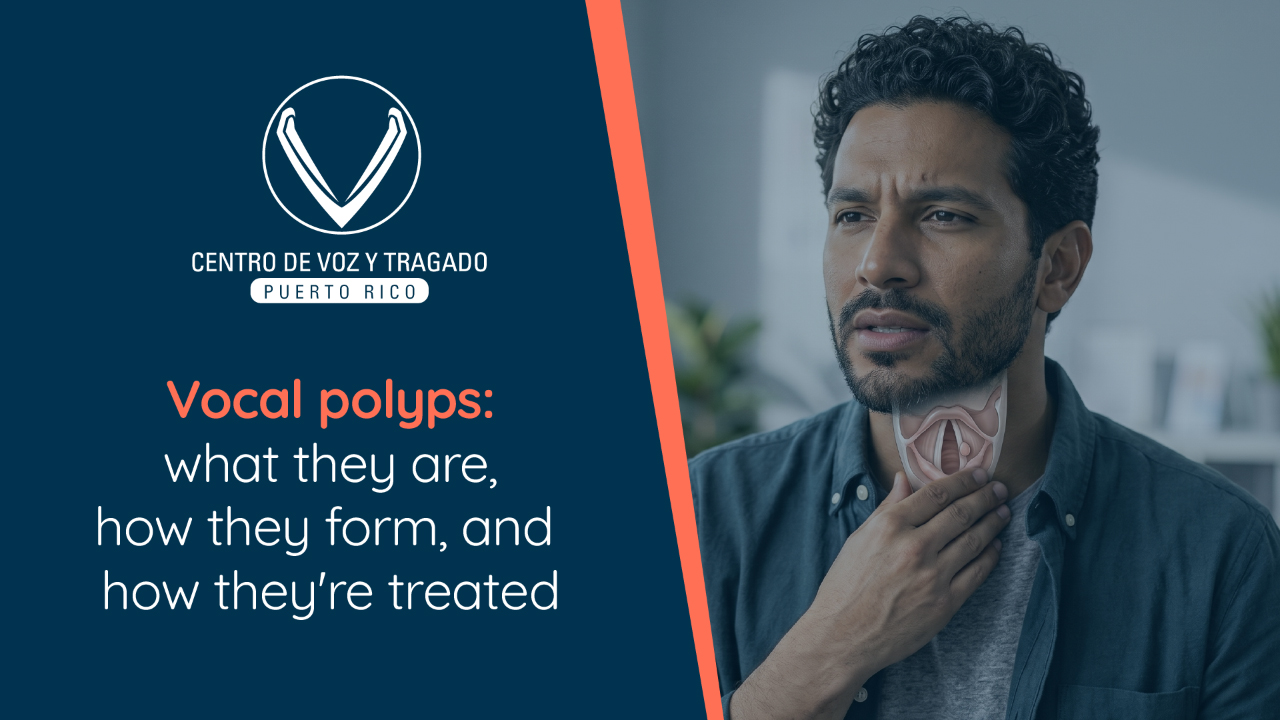
If you’ve ever boiled water and noticed a bubble form on the surface before it bursts, you have a rough picture of what a vocal polyp is. It’s not exactly that, of course, but the analogy helps: a polyp is a soft lesion, usually filled with fluid or blood vessels, that grows on the free edge of a vocal cord and profoundly alters voice quality.
Vocal polyps are one of the most common benign lesions, and although the word “polyp” can cause concern, the vast majority of cases have effective treatment.
What exactly is a vocal polyp?
A vocal polyp is a benign mass that forms in the superficial layer of the vocal cord, specifically in Reinke’s space, the layer of gelatinous tissue that allows vibration. Unlike nodules, which are bilateral and symmetrical like calluses, polyps are usually one-sided, appearing on a single vocal cord, and can vary in shape and size.
There are two main types. Hemorrhagic polyps, which have a reddish color due to dilated blood vessels and accumulated blood, and edematous or hyaline polyps, which are translucent and filled with gelatinous fluid. Both types disrupt the normal vibration of the vocal cord and produce a hoarse, breathy voice that requires effort to produce.
How do they form?
The formation of a vocal polyp is generally the result of an acute traumatic event in the vocal cord, unlike nodules, which form from chronic repetitive trauma. The classic scenario is someone who shouted intensely at a concert, a sporting event, or a heated argument, and woke up the next day with a completely different voice.
What happens at the microscopic level is that excessive vocal effort causes small blood vessels in Reinke’s space to rupture. Blood and fluid accumulate, generating localized inflammation. If this inflammation doesn’t resolve, it organizes and becomes an established polyp.
Several factors predispose someone to polyp formation. Smoking is a major factor because it causes chronic inflammation and vascular fragility in the laryngeal mucosa. Laryngopharyngeal reflux contributes to mucosal damage and disrupts microcirculation. Use of blood thinners or aspirin can facilitate submucosal hemorrhage. And sustained vocal abuse, though more associated with nodules, can also culminate in a polyp.
Symptoms
The cardinal symptom of a vocal polyp is hoarseness. But not just any hoarseness: it’s hoarseness that appears relatively suddenly and doesn’t improve over time. Unlike viral laryngitis, which resolves in one to two weeks, hoarseness from a polyp persists and can gradually worsen.
Other symptoms include a breathy or airy voice, vocal fatigue, a sensation of effort when speaking, voice breaks, reduced vocal range, and, with larger polyps, even mild breathing difficulty. Singers notice loss of high notes and difficulty with the passaggio, the transition zone between vocal registers.
Diagnosis
Diagnosis is made using videostroboscopy. This technique allows detailed visualization of the polyp, assessing its size, location, vascularity, and, most importantly, how it affects vocal cord vibration.
Stroboscopy shows the mucosal wave, that wave-like movement of the vocal cord surface that is essential for sound production. A polyp typically stops or severely disrupts the mucosal wave in the area where it’s located, and can affect the vibration of both vocal cords if it’s large enough to prevent glottic closure.
Treatment
Treatment of vocal cord polyps depends on their size, symptoms, and response to conservative measures. It always starts with a period of voice therapy and elimination of contributing factors. In some cases, especially recent, small polyps, these measures can be enough to achieve resolution or significant improvement. In most cases, these polyps can be treated with awake office-based laser treatment, but some patients are candidates for surgery. Laryngeal microsurgery is performed under general anesthesia, using a suspension laryngoscope and an operating microscope that gives me a wide, three-dimensional view of the vocal cords.
The surgical technique is meticulous. Using microinstruments or a laser, I make a precise incision on the surface of the vocal cord, identify the correct dissection planes, and remove the polyp while preserving as much normal mucosa and lamina propria as possible. Every micron of healthy tissue I preserve translates into better postoperative voice quality.
After surgery
The postoperative period is just as important as the surgery itself. I generally prescribe three to seven days of absolute voice rest, meaning no talking, no whispering, no throat clearing. After that, a gradual voice reintroduction program begins with supervised voice therapy.
Complete voice recovery takes four to six weeks. It’s a process that requires patience. The vocal cord needs time to heal, for the mucosa to re-epithelialize, and for the mucosal wave to be restored.
Prevention
To prevent recurrence, I work with the patient to modify the factors that contributed to the polyp’s formation. If they smoke, we quit smoking. If there’s reflux, we treat it aggressively. If there are patterns of vocal abuse, voice therapy teaches more efficient, healthier techniques for voice production.
My philosophy is that surgery solves the current problem, but prevention ensures it doesn’t come back. It’s teamwork between the patient, the laryngologist, and the speech-language pathologist.